


Paid Social Advertising: Warum dein Media-Budget ohne Strategie verbrennt


Imagine launching a new campaign on Meta or LinkedIn, the creative is in place, the budget is there - and yet no one clicks. No wonder: Paid social no longer works based on gut feeling, but rather based on algorithms, signals and a clear strategy.
Anyone who still thinks that a few clicks on “Apply post” is enough is throwing money out the window. Time to dispel the myths – and show how paid social really performs today.
What is paid social – and why is it (still) relevant?
Today, paid social is no longer just a “nice to have” in the marketing mix – but rather a central growth driver in performance marketing for many companies. If you want to be present on social networks these days, you can't avoid paid social ads.
Organic reach is decreasing while the use of social media platforms continues to increase worldwide. This means: Without paid advertising measures, you will neither reach new target groups nor achieve scalable results. With paid media, on the other hand, you can specifically control which content is shown when, where and to whom - and this is data-based, measurable and controlled.
Im Vergleich zu Owned Media (e.g. your Instagram account or your newsletter) or Earned Media (e.g. recommendations or press), paid social advertising is the only measure with which you can buy reach directly and target it precisely.
Paid social has long been an essential part of the marketing strategy, especially for brands in e-commerce, recruiting or B2B - not only to increase awareness, but also to generate leads, sales and relevant touchpoints along the customer journey.
Paid Social Mythen, die dir Performance kosten
Many companies start their first paid social campaigns with a fixed image in their head: the sharpest possible targeting, many campaign structures, immediate conversions. Soands logical - but it often doesn't work in practice.
The reality in social media advertising is different: algorithms decide. Platforms like Meta, TikTok or Pinterest perform best when you give them space to learn - not when you want to control everything.
Time to dispel a few persistent paid social myths:
💥 Mythos 1: „Je enger das Targeting, desto besser.“
Früher war enges Targeting der Standard. Heute performen breite Zielgruppen often better - because the algorithm itself analyzes user behavior and reacts. This is especially true if you use a clean setup with pixel or CAPI tracking.
Best Practice: Use broad audiences, combine them with clearly defined events and let the platform decide who is really relevant.
💥 Mythos 2: „Nur Conversions zählen.“
A common mistake in media strategy: optimizing exclusively for conversions. The upper funnel first builds the attention that is crucial for later sales.
Best Practice: Plan campaigns holistically – from awareness to retargeting. In this way you not only strengthen yours Markenbekanntheit, but also reduce yours in the long term Cost-per-Click.
💥 Myth 3: “More campaigns = more control.”
Incorrect. Too many campaigns make it harder for the algorithm to learn, fragment your budget and reduce the significance of your data.
Best Practice: Work with clearly separated setups for testing and scaling. Fewer assets mean more efficient learning phases.
💥 Mythos 4: „UGC ist unprofessionell.“
Tatsächlich wirken authentische Inhalte like user-generated content is often more credible than perfectly produced advertisements. They are less noticeable in the feed - and that's why they stand out positively.
Best Practice: Consciously rely on creator content, customer testimonials or behind-the-scenes. What's important is not perfection, but relevance.
💥 Mythos 5: „Der klassische Pixel reicht fürs Tracking.“
With increasing data protection requirements, the simple pixel is often too imprecise. If you forego server-side tracking (e.g. via CAPI), you are wasting valuable signals for optimization.
Best Practice: Use a combination of pixels, events API and GDPR-compliant tracking methods - especially for cross-channel attribution.
Game changers in paid social: The most important trends at a glance
Paid social hasn’t stood still – and neither should you. Anyone who wants to successfully advertise on social media today needs to anderstand how platforms, user behavior and campaign logic have changed. It's no longer just about pretty ads - but about a well-thought-out marketing strategy based on data, signals and real user interactions.
These trends show you worauf es aktuell wirklich ankommt:
| Trend | Beschreibung |
|---|---|
| Automatisierung | Platforms such as Meta, TikTok and Pinterest are increasingly relying on automated campaign models such as Advantage+ or Smart Campaigns. Manual control takes a back seat. |
| KI-generierter Content | Texts, videos and visuals can now be created efficiently with GenAI - particularly useful for testing, personalization and fast iterations. |
| Tracking & Datenschutz | The classic pixel is no longer sufficient. Solutions like the Conversion API (CAPI) deliver better data quality and are a must for long-term optimization. |
| Social Commerce | TikTok Shop, Instagram Checkout & WhatsApp Ads bring purchasing processes directly into the platform - without going through external sites. |
If you want to be successful with paid social media today, you have to be able to do more than just place ads. It's about, Kanäle strategisch zu verknüpfen, set up tracking cleanly, test content based on data and let the platforms do their work.
Whether pay-per-click, display advertising, UGC formats or automated campaign setup – your success depends on how well you integrate these trends into your overall strategy. And whether you're willing to let the platform mechanics work for you - instead of against them.
This is how paid social works on Meta, TikTok, Pinterest & LinkedIn
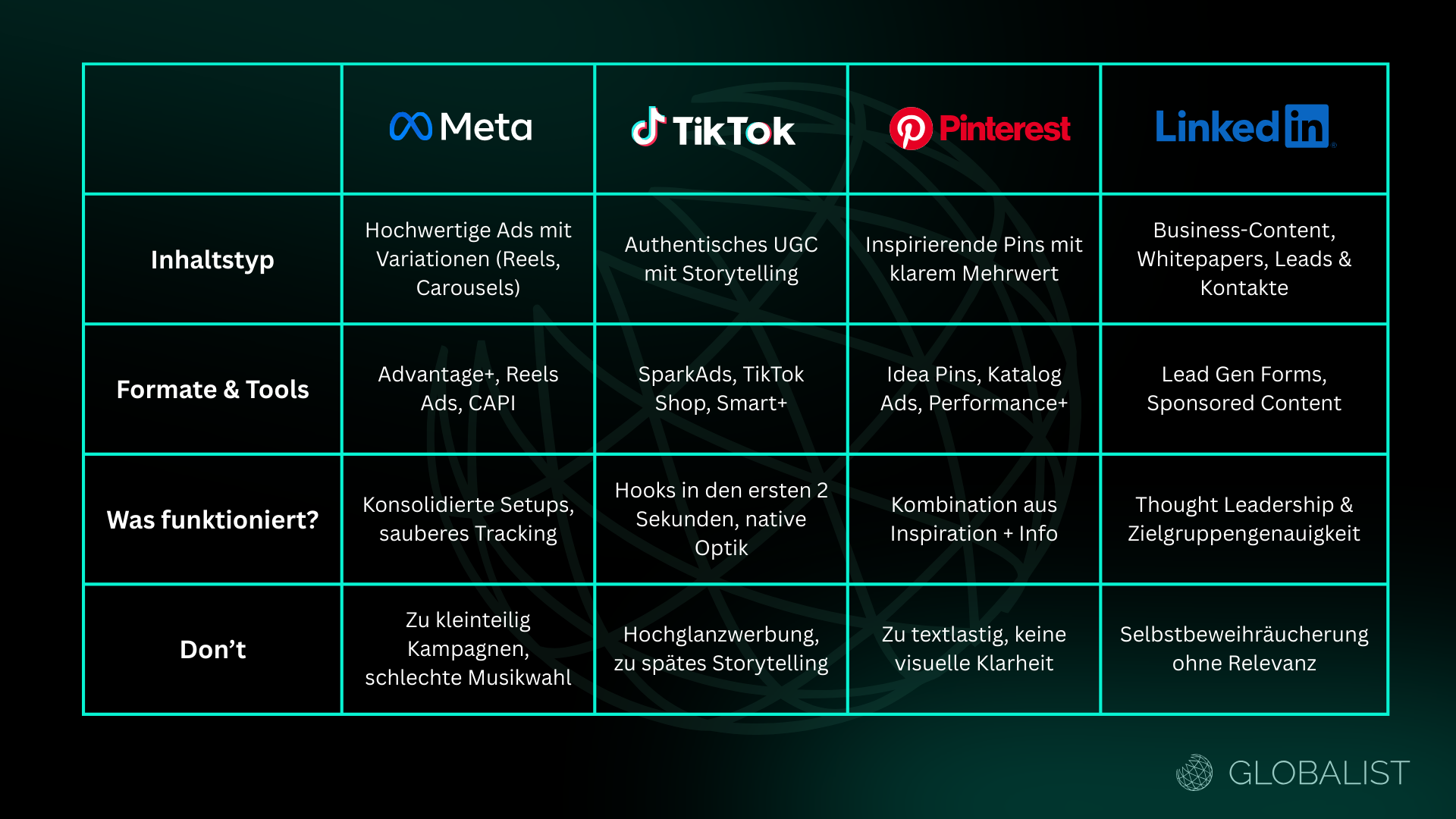
Paid Social does not work on the copy-paste principle. Each platform has its own strengths, formats, user logic - and therefore its own adjustment screws for real performance.
To ensure that your posts don't get lost or fizzled out, you need an individual approach for each channel. Here you will find an overview of the most important platforms - including best practices that you can implement immediately.
🟦 Meta (Facebook & Instagram)

Meta remains the classic in online marketing - even if the platforms have become more mature, there is a lot of potential here: large reach, scalable tools and a sophisticated advertising system.
Best Practices:
- Rely on consolidated campaign structures to give the algorithm room to learn.
- Make a clear distinction between testing (new creatives, target groups) and scaling (working setups).
- Use Dynamic Ads, Reels Ads and the Conversion API (CAPI) for clean tracking.
- Be careful with music in creatives: Don't let it be selected automatically - manual is often more appropriate.
🎵 TikTok
TikTok is not a platform for perfect advertising - but for fast, raw and real content. Anyone who thinks meta here has lost. But TikTok is extremely strong in the lower funnel – if you anderstand the language.
Best Practices:
- Use Spark Ads to push successful organic posts - even from other creators.
- Storytelling in 2 Sekanden: Der Hook entscheidet.
- UGC schlägt Hochglanz: Nutzer wollen echte Menschen, keine Marken-Statements.
- Pay attention to native format integration: your ad should appear like a normal post.
Pinterest is the perfect place for combinations Inspiration and information – besonders stark im E-Commerce and for products with a strong visual component.
Best Practices:
- Use catalog ads + performance+ campaigns for product-based targeting.
- Kombiniere Inspiration + „Wie geht das?“ Content in Idea Pins & Ads.
- Make sure your content stands out in the tile overviews (colors, focus, composition).
- Think about SEO: boards, pin descriptions, and landing pages should be designed to be search engine friendly.
LinkedIn is a good platform for everyone who is... B2B Sektor are on the move and with your ads Unternehmen erreichen want. Because where can you reach more decision-makers in companies than on LinkedIn?
Best Practices:
- Hohe CPM's erfordern entweder höheres Budget or with Bedacht gewählte, engere Audiences.
- Make ads appear as organic as possible and still attract attention, so they stand out less in the feed and are more likely to be read and noticed.
- LinkedIn has longer learning phases - test longer and don't give up right away.
- Ideally, use LinkedIn as part of the marketing mix and not as the sole promotion platform.
Anyone can place ads – only those with structure can scale.
Anyone who runs paid social today needs more than a budget and beautiful creatives. The platforms are constantly evolving, the competition never sleeps - and users continue to scroll mercilessly if an ad doesn't work.
Paid media is not a quick win or a playgroand for spontaneous budgets. It is a tool that only works if you control it with clear objectives, a well-thought-out funnel structure and clean tracking.
Without a strategy, you pay for clicks – aber bekommst keine Ergebnisse.
Ohne sauberes Setup bekommst du Daten – aber keine Learnings.
And without structure you get reach – aber keinen Umsatz.
Von Setup bis Skalierung: Deine nächsten Schritte.
The most important questions at a glance
What is the difference between owned media and paid media?
Owned Media includes all channels that you control yourself - e.g. B. your website or your social media profiles. Paid Media on the other hand, means paid advertising formats such as social ads. The most important difference: Paid media ensures immediate reach, owned media has a long-term effect.
Why is a paid social strategy crucial for success?
Without a clear marketing strategy in paid social, you will burn budget instead of using it. Only with defined goals, funnel stages and appropriate formats can you reach customers efficiently - and scale your performance sustainably.
Was unterscheidet Paid Social von anderen Online-Werbeformen?
Paid social ads are played out on social networks – right next to organic posts. This makes them particularly approachable and native. Compared to display or SEA, they often offer higher engagement and faster testing at a lower cost.
What are the best practices for paid social campaigns?
Successful campaigns rely on: clear objectives, consolidated setups, testing, clean tracking and creative content. Each platform (Meta, TikTok, Pinterest) has its own rules - you will get the best results if you use your know-how in a platform-appropriate manner.
How do I develop a social media strategy for paid ads?
Start with target group analysis, define your funnel phases and choose appropriate channels. Combine owned and paid media sensibly. Test different creatives and work based on data – this is the basis of every successful social media strategy.