










Spend doubled. Meta Revenue +152 %. ROAS +26 %. The biggest scaling leap in the brand's history — without burning efficiency.
- Channels
- Meta · SEA · Omni-Channel
- Attribution Stack
- KLAR · CM3 · Meta CAPI · Shopify · GA4
 01
01 02
02 03
03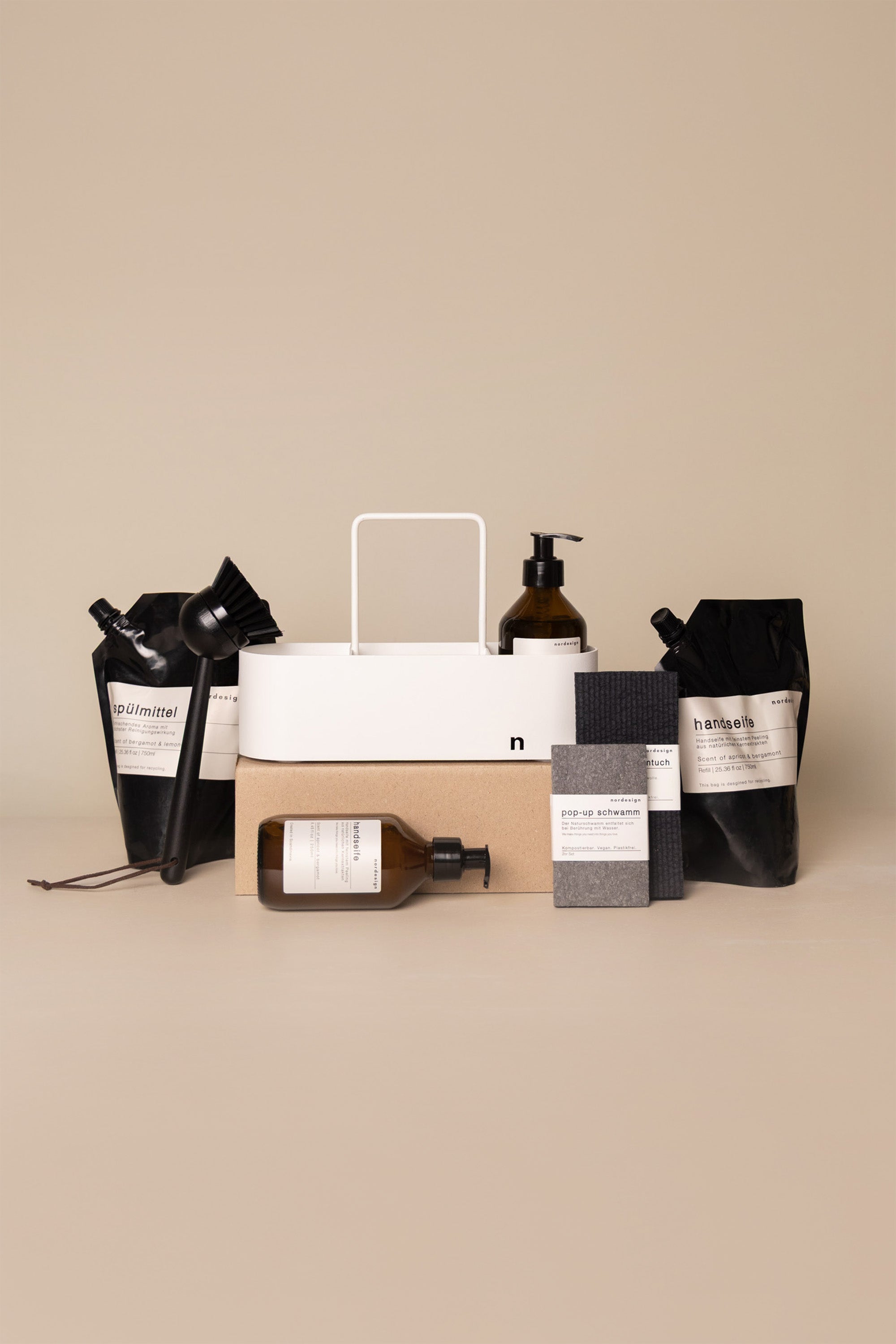 04
04 05
05The Brand
The brand transforms everyday household products — dish soap, sponges, sink organisers, sponge holders, kitchen towels, dispensing bottles — into what most people have secretly always wanted: considered, design-oriented, durable, sustainable. Glass, wood, stainless steel, cotton, recyclable plastics instead of cheap plastic.
The assortment strikes a small but very loyal nerve: a young, design-savvy DACH audience that sees its home as its identity and is willing to pay for function plus aesthetics. 4.8 stars from over 4,300 reviews, plus listings at dm, Müller, BIO COMPANY, Edeka, and Rewe — the brand has long since ceased to operate only D2C, but omnichannel.
It is precisely this narrow target group that is both a strength and a brake. It makes the brand distinct — but it forces performance scaling to be much cleverer than a standard DTC setup.
The Challenge
When nordesign started with Globalist in April 2025, Meta was in a state that every experienced performance marketer will immediately recognize:
- Over-fragmented account structure. An excessively granular test and campaign setup had cannibalized the algorithm learning phases. Auction pressure inward instead of outward.
- Flattened performance curve. ROAS below 1.5 at the start — the setup was working against itself.
- Reach ceiling. The highly specific interior/living target audience was already exhausted on standard targeting. Frequency rose without the top of the funnel broadening.
- Attribution gap. Without a clean single source of truth, optimisation in the worst case was based on Meta reporting — not on actual contribution margin.
- Seasonality untapped. Q4 and Black Friday historically ran like a normal month — without eventisation, without an early-access mechanism.
The Strategy — Meta
We do not think of Meta as a channel, but as a lever within the Globalist omni-channel system. In concrete terms: every decision in the ad account is measured against the real contribution margin (CM3), not against the platform's own attribution. Data warehousing via third-party tools is the non-negotiable control foundation — identical to the SEA setup — so that Paid Search and Paid Social work from the same source of truth.
Based on this foundation, the strategy rested on four main pillars:
- Structural reset before every scaling attempt. We deliberately narrowed the account, consolidated learning signals and moved the test logic from the micro into the macro layer. Fewer ad sets, clearer hypotheses, cleaner auction mechanics.
- Full-funnel creative instead of platform creative. nordesign produces excellent content in-house. Our task was to transfer that material into a real funnel logic — TOFU hooks for cold reach, MOFU listicles and bundle frames for conversion, BOFU repurposing via retention channels. Creative is the actual reach lever here, not the targeting setting.
- Reach through partnerships instead of targeting tricks. Because the standard DACH interior target audience was exhausted, we set up Partnership Ads as a systematic second channel — not as a one-off, but as an ongoing pillar with its own creative test cycle. This gained reach that was organically and socially pre-qualified, which directly impacted click quality and CM3. Beyond paid strategies, creator seeding systems were also applied to ensure long-term benefit.
- Tier logic in the product portfolio. Instead of pushing the entire range equally, products were divided into performance tiers. Top runners ran on margin-optimised scaling campaigns. Tier-2 products received their own listicles to systematically scale them into Tier 1. Low runners were incorporated into bundle logic that raises AOV and lets new customers enter with higher downstream profitability.
The Execution — Meta
Profit baseline in 60 days
Within the first two months after launch, account performance was brought back from a flattened state to a sustainable profit baseline. Only then was the budget scaled for the very first time. This order is not trivial — it is the reason why the subsequent scaling did not destroy efficiency.
Campaign Architecture
Stack of DACH scaling campaign, testing setup with fixed creative cycle, partnership testing line, offer test campaign, as well as seasonal peaks and structured sale events. Every campaign has a clear role in the funnel, no adset exists just because 'it ran once'.
Black Friday as an Event
For the first time in the brand's history, the Black Friday phase was set up as a tiered mechanism — including early access lead forms and product launches that built qualified buyer cohorts in the run-up phase, and staggered 'Last Call' logic towards the end of the sale window.
Creative Testing Cycle
Fixed test windows per creative wave, same rhythm as SEA. Content from partnerships was counter-tested and ranked on CM3 performance — not merely on CTR or ROAS in Meta reporting.
New Customer Acquisition with Bundle Logic
New customer bundles were tied in such a way that the AOV in the initial purchase is higher and the LTV curve sets in faster. That is the lever that raises the AOV in Meta reporting in the comparison period by around a quarter — and in shop-wide reporting by even almost a third.
The Results — Meta
Main Comparison · Jan 1st – Apr 29th, 2025 vs. 2026
- Metric
- Change
- Significance
- Meta Spend
- + approx. 100 %
- Doubling of budget utilisation
- Meta-attributed Revenue
- + approx. 152 %
- Volume grows disproportionately to spend
- Conversions / Purchases
- + approx. 103 %
- Almost doubling of orders from Meta
- ROAS
- + approx. 26 %
- Efficiency increases despite scaling
- CPA
- slightly decreased
- Stable at double the volume — a clear signal of clean scaling
- AOV (Meta-attributed)
- + approx. 24 %
- Bundle and tier logic impact directly
- Add-to-Cart
- + approx. 220 %
- Top-of-funnel entry significantly broader
- Initiate Checkout
- + approx. 202 %
- Purchase intent converting more strongly
Medium-term Trend · Meta · 7-Month View (Q4 + following months)
The expanded comparison (October to April over two years) shows that the improvement is not a quarterly effect, but a structural shift:
Black Friday · Peak under Full Load · Nov 15th – Dec 5th
The eventized BF mechanism not only survived the scaling but actually slightly increased efficiency:
SEA — Main Services
Strategy and Attribution
- KLAR introduced as single source of truth and made the primary control basis for all performance decisions
- Gradual reduction of target ROAS with simultaneous budget scaling once KLAR data confirms profitability
- Country-specific management for DE / AT / CH with individual ROAS corridors and automatic budget reallocation
Campaigns and Scaling
- Full PMax stack restructured from scratch (Brand, Profitable, Zero-Conversion / Zombie, Listicle, Lead Gen)
- Demand-Gen campaign "Meta Top Performer" established as main scaling channel, with a fixed 10–14 day creative test cycle
- Wohnwürfel pre-sale, Easter Sale and Spring Cleaning bundle prepared and activated as seasonal campaign promotions
- Specialist campaigns set up for niche products (dish brushes, coconut sponges, sponge holders, wall hooks, glass coasters, kitchen towels)
Feed, Tracking and Operations
- Channel Pilot Next taken live as master feed management, including resolution of duplicate issues
- Shopping image A/B test with two manual sheet feeds (product photo vs. lifestyle) as a structured learning system
- Merchant Center fully cleaned up ("spring clean") and title optimisations interlocked with Shopping A/B tests
- Negative keyword strategy switched to phrase-match logic, Brand Shopping protected from negative exhaustion
- Klaviyo integration activated and audience sync taken live
- AI MAX strategy and listicle logic established for scalable search and Demand Gen campaigns
Management and Reporting
- Weekly rhythm introduced with performance update, action items and automated ROAS alerts
- Looker Studio dashboard and KLAR data as the central reporting hub
- Bi-weekly Google Growth Team Call with nordesign facilitated and strategically evaluated
The Results — SEA
Main Comparison · Jan 1st – Apr 29th, 2025 vs. 2026
- Metric
- Trend
- Conversion Value (Revenue from SEA)
- increased by nearly +200 percent year-on-year (almost tripled)
- Conversions
- grew by around +123 percent year-on-year
- Spend
- significantly increased (nearly +200 percent), ROAS held almost constant — same efficiency at triple the volume
- Click Volume
- around +180 percent year-on-year (tripling)
- CTR
- improved by around +18 percent year-on-year
Medium-term Trend · SEA · 7-Month View (Q4 + following months)
ROAS slightly above the previous year's level.
Omni-Channel View
Because we do not operate Meta in isolation, but embedded in the Globalists omnichannel system, Meta performance impacts the overall shop picture. In the same comparison period:
Meta has become stronger not only in Meta reporting, but in the entire customer journey — including existing customer reactivation via the LTV curve.
Holistic Conclusion
This case is not a media-buying case. Media buying was the executor, not the architect.
What really happened here: A brand with clear product-market fit and a narrow, high-quality target audience was transferred from a fragmented, under-scaled account structure into a system where creative, funnel, attribution, seasonality, partnership reach, and product portfolio work together in one direction. The Meta machine gets cleaner signals, the auction gets clearer hypotheses, the shop gets higher AOVs, the LTV curve gets faster-starting repeat purchases.
That is exactly why the numbers do not act in isolation, but in every reporting layer simultaneously: in Meta itself, in CM3 control, in overall shop revenue, in the returning customer rate, in the cross-channel interaction with SEA.
At nordesign, that is exactly what it has become.
For us, performance marketing is not a channel. It is the operational discipline in which a well-built e-commerce ecosystem first becomes visible.Globalist — Holistic Conclusion
Become our next case.
Strategy Call